The House of the Grey Mists at Crosswind

The House of the Grey Mists at Crosswind is a protected house of passage at a wind-swept crossing. It serves travelers, the wounded, and those who must pause for a time. People arrive for a night, a winter, or only for a meal. Some remain longer. Many move on.The community lives without ranks, but not without responsibility. Tasks follow skill and need: Those who cook, cook. Those who heal, tend wounds. Those who are watchful, keep watch.The faith of the house is rooted in respect for life and in the deliberate shaping of transitions. Rituals are used to clarify paths, steady steps, and guide people part of the way through change. Participation is invited, never forced.
Above the gate stands no commandment, only an observation:The way continues.
About the House
The House of the Grey Mists at Crosswind (or short, just “Crosswind”) stands where the wind rarely rests and roads meet. It is neither an ascetic cloister nor a defenseless sanctuary, but a protected house of passage. People come for a night, a winter, or only for a meal. Some stay until a wound heals or a decision takes shape. Others move on as soon as the road allows.The community has no hierarchy, but it does have responsibility. Tasks arise from skill, experience, and need. Those who can write keep records. Those who know the land tend the soil. Those who read maps and judge roads maintain the archives. Watchkeepers guard the gate, especially at night. Roles change with circumstance and are not bound to titles.
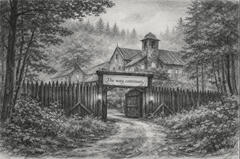
A fundamental respect for life shapes daily life in the house. Out of conviction and practical sense, meals are prepared without animal products. Provisions are meant to last, to nourish, and to remain safe on long journeys. This practice is not a moral demand placed on others, but part of the house’s own responsibility.The faith of the house is not directed toward gods or commandments, but toward transitions. Birth, travel, illness, healing, and death are understood as movements each soul passes through. Rituals are used to deliberately shape these transitions: they structure action, focus attention, and give direction to change without claiming control over it. Closeness may be offered; withdrawal is respected.The house is not without protection. Walls, palisades, and a fortified shelter secure the grounds. It also stands under the protection of nobles and merchant guilds who rely on it as a safe haven for messengers and travelers. Violence and plunder are not tolerated, but resisted.From the house, individuals or small groups regularly set out. Elsewhere they may be known as companions, pathfinders, or chroniclers. They do not proselytize, demand exclusivity, or claim interpretive authority. Their rituals are practical, concise, and focused on the moment. They invite participation and guide transitions without coercion.The sign of the house is a stylized forked road in mist. It may also be read as a wave, a moment, or a sheltered figure. It is worn or displayed by choice, or not at all.
Above the gate stands no creed, only a simple observation:“The way continues.”
What we do
Those of the House of the Grey Mists are found on the road.
We travel with the caravans, along the edges of camps, between gates and borders, and through places where people gather only for a short while. We carry what we need and little more. Where we stay is temporary. Where we move on from matters.
We accompany moments of change.
When someone sets out, returns, hesitates, or reaches a point where the way ahead feels uncertain, we may offer to walk with them for a time.
Our rituals are shaped for the road.
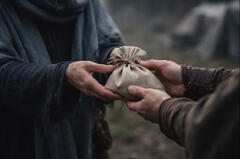
They are practical, clear, and grounded in action: walking, marking, handing something over, sharing attention. They are meant to give a step firmness, a moment clarity, or a transition direction.
They are offered, not imposed.
They begin with an invitation and end when the next step is possible.
We tend to what keeps people moving.
Much of what we do looks ordinary.
We share food meant for travel.
We help bind wounds or ease exhaustion.
We point out paths, dangers, and safer ways through unfamiliar ground.
We stand watch when needed and step back when we are not.
There is no fixed place for this. It happens where people are.We listen along the way.
Some of us keep a chronicle of the journey.
Not of victories or leaders, but of what happens between them:
a shared meal at the edge of a camp,
a decision made quietly,
someone leaving before dawn.
These things are written down so they are not lost entirely.
Nothing is recorded without consent.
We carry words when asked.
At times, we are asked to carry messages between people or groups who cannot or will not speak directly. We carry these words as they were given and return with an answer, if there is one.
We do not judge the message.
We do not alter it.We do not claim land or ownership.
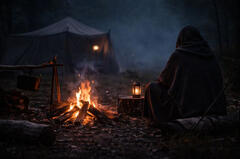
We may raise temporary shrines, portable altars, or simple markers where the road requires it: at a gate, a fire, a crossing, or a farewell. These are made to serve a moment and are taken down again when their purpose is fulfilled.
We do not build permanent temples on ground that is not ours.
We do not demand allegiance.
We do not ask anyone to stay.
We walk with those who ask for company.
When the road turns elsewhere, we let go.
For Players (OOC)
This website describes a fictional group portrayed in Live Action Roleplay (LARP).LARP is a form of collaborative storytelling in which participants physically portray characters in a fictional world, similar to improvisational theatre, but without a script or audience. Everything described here refers to in-character play, not real-world beliefs or practices.If you are unfamiliar with LARP, you can find a short explanation here: What is LARP? (external link)The following section contains out-of-character information for players.
General approachOur play focuses on atmosphere, consent, and practical interaction.
We aim for calm, grounded scenes rather than spectacle or preaching.Encounters are always meant as an offer, never an obligation.Ritual play✦ Rituals only happen with explicit consent
✦ Participation is always voluntary
✦ Anyone can step out of a ritual at any time, without explanation
✦ Rituals are guided, but never coercive
✦ There is no expectation of belief, emotional reaction, or interpretation
✦ If you are unsure, saying “no” or “not now” is always fine.What players often come to us forMany interactions with the House of the Grey Mists are very simple and practical.
Common reasons players approach us include:
✦ plant-based snacks and travel food
✦ drawing small fortune slips, sayings, or thoughts from a pouch or vessel
✦ trading, buying, or exchanging talismans and good-luck items
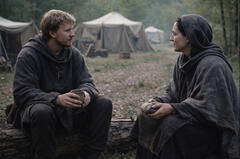
✦ in-character soul care, quiet conversation, or grounding presence
✦ practical questions like: “Do you know where I can find…?”These interactions are meant to be light, optional, and low-threshold.
You are welcome to engage briefly or stay longer, as it fits your play.Situational offers in other campsDepending on time, place, and situation, members of the House may also offer:
✦ storytelling and sharing of tales
✦ simple narrative games using storytelling stones (for adults and children alike)
✦ bardic singing or musical interludesThese moments are meant to create connection and pause, not performance pressure.
Themes & boundariesOur play may include:
✦ transitions (departure, return, change, loss)
✦ quiet or focused moments
✦ light physical interaction (e.g. handing objects, walking together)It does not include:
✦ religious pressure or conversion
✦ judgment of characters or beliefs
✦ forced intimacy, touch, or emotional escalationIf something feels uncomfortable, please speak up at any time.Joining & affiliationThere is no formal joining process.
✦ No oaths
✦ No exclusive membership
✦ Dual or multiple affiliations are explicitly welcomeIf you enjoy the style of play, you are welcome to walk alongside us for a while.
If not, that is equally valid.Practical notes✦ We are happy to adjust intensity, tone, or length of scenes
✦ We enjoy quiet roleplay just as much as interaction-heavy scenes
✦ We are always open to short OOC check-insYou can approach us in or out of character if you have questions.
Signs & Symbols
The House of the Grey Mists uses few symbols.What marks us is not uniformity, but recognition.

The Sign of the Forked WayThe most common sign associated with the Grey Mists is a stylized forked path in mist.It may be read in different ways:
✦ as a road that divides and leads to many places
✦ as a wave that rises and falls, passing and marking the line between the land and sea
✦ as a moment held between movement and stillness
✦ as a figure sheltered, not boundNone of these readings is considered final.
Use of symbolsThe sign may appear:
✦ on a small banner carried on the road
✦ painted on skin, stone, wood, or fabric
✦ carved into a temporary marker or altarIt is never required.
It is never assigned.Some carry it openly.
Some only for a time.
Some not at all.MeaningThe sign does not grant authority.
It does not mark territory.
It does not demand recognition.It simply indicates that someone has chosen, for now, to walk with the Grey Mists.
The Chronicle
Those of the Grey Mists keep a chronicle of the road.The Chronicle is not exhaustive.
It does not claim truth beyond the moment it records.It is not written to glorify deeds or to preserve authority.
It is written so that what was learned does not have to be learned again.Names are recorded when they are given.
Places are named when they matter.
Small details are kept, because they often decide whether a way remains open or closes.Some entries are kept brief.
Some are crossed out later.
All of them are written with permission.What is written downThe Chronicle concerns itself with transitions:
✦ arrival and departure
✦ access granted or denied
✦ moments where a way changed, opened, or endedEntries are practical. They note what worked, what failed, and what carried someone through.

Excerpts from the Chronicle"Kareth, third day at the eastern gate of the Command Camp.
The officer on duty said I should not return without proper papers. I offered biscuits to the gate guard instead. They were accepted. Access was granted shortly after.
Note: biscuits are an effective door-opener.""Mira of the Riverlands, edge of the northern camp.
She hesitated to leave at dawn. We walked the first stretch together. At the second marker stone, she continued alone.
No ritual was needed beyond that.""Hannes, injured near the old road.
Wanted to keep walking despite the wound. We stopped. Food was shared. The bandage held.
He stayed one night longer than planned.""Branwen and Cedric, after the argument near the fire.
Words were carried between them, unchanged. They did not agree, but they continued working side by side."PurposeThe Chronicle serves those who come after.It reminds us:
✦ where caution was needed
✦ where generosity opened a way
✦ where force would have failedIt is a map of experience, not of territory.